








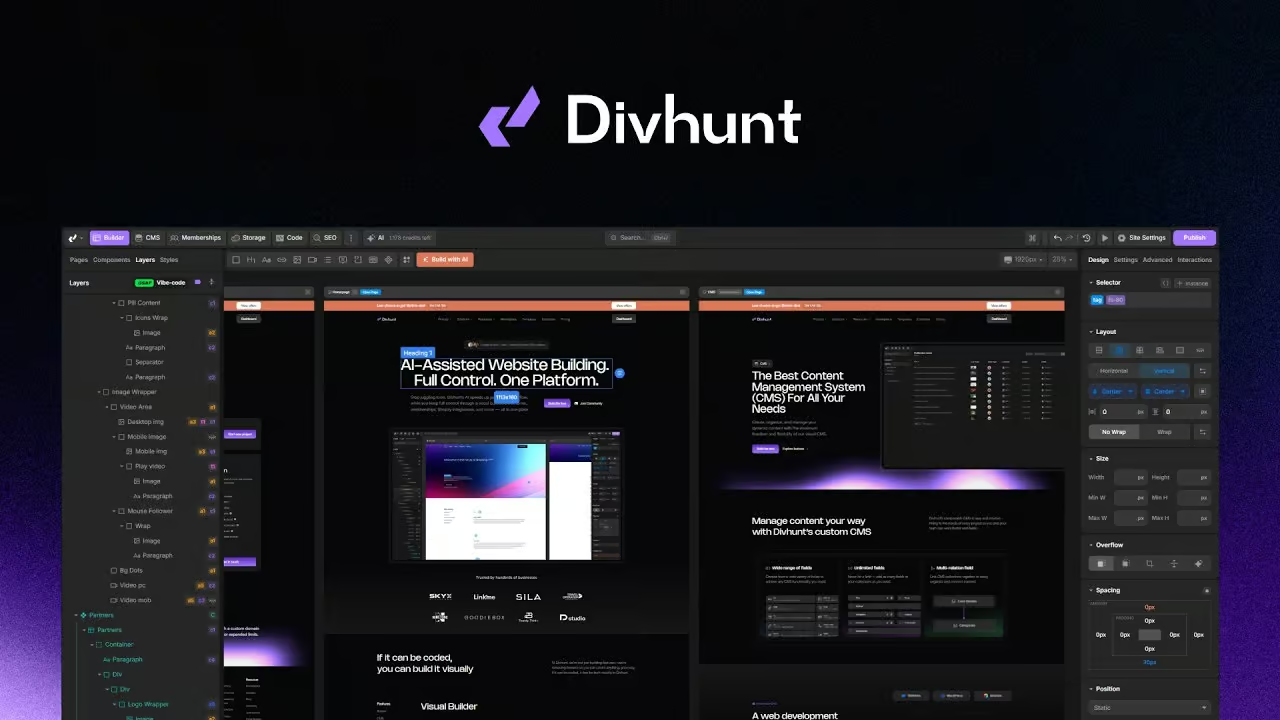

Divhunt allows you to set global SEO settings in the project settings. These settings provide default values for every new page created and control site-level SEO aspects.
General Settings
Description
- This is the default description used as meta and Open Graph (OG) description if not overridden in page settings. It provides a summary of your page content.
- Enter a concise and engaging description that accurately summarizes your website or business.
- Keep it between 100 and 160 characters for the best results. This ensures your description is fully visible in search engine results.
OG Image
- This is the default thumbnail displayed when the website is shared on social media. Each page can define its own OG image, but you can set a default one here to ensure a consistent visual representation.
- Use an image with a resolution of 1200x630 pixels and a size not exceeding 1MB.
These settings are used as defaults for new pages. You can override them in individual page settings.
Sitemap Settings
Sitemaps help search engines discover and index the pages on your site. In Divhunt, you can configure which pages and collections should be included in the sitemap.
Pages
- Toggle to include or exclude all pages with indexing set to true in the sitemap.
- Turn on the toggle to ensure all important pages are included in the sitemap.
- Enabling this ensures that all your important pages are indexed by search engines, improving your site's visibility.
Collections
- Toggle to include specific collections in the sitemap. Collections are groups of similar items, like blog posts or product listings.
- Turn on the toggle for each collection you want search engines to index.
- Include collections that are important for your site's SEO to ensure they are indexed by search engines.
Custom Sitemap
- Manually edit the sitemap for advanced users who need to include links from a third-party CMS.
- Click to edit and manually add or remove links in the sitemap.
- Only edit manually if you are experienced. Mistakes can prevent your site from being indexed correctly.
Adjusting the sitemap helps control what content search engines can discover and index.
Robots.txt Settings
The robots.txt file tells search engine bots which pages they can and cannot crawl on your site. Proper configuration of robots.txt helps guide search engine bots on what pages to crawl and index.
User-agent
- Defines the web crawler to which the rule applies.
- Example: 'User-agent: Bingbot' applies the rule to Bing's web crawler.
Disallow
- Blocks crawlers from accessing specific parts of the site.
- Example: 'Disallow: /private' prevents crawlers from accessing any URL that starts with /private.
Allow
- Allows crawlers to access specific parts of the site, even within a disallowed parent directory.
- Example: 'Allow: /public' allows crawlers to access any URL that starts with /public.
Crawl-delay
- Specifies the number of seconds a crawler should wait between requests to the server.
- Example: 'Crawl-delay: 10' tells crawlers to wait 10 seconds between requests.
Host
- Specifies the preferred domain for the site. Useful for sites with multiple domains.
- Example: 'Host: www.example.com'
Sitemap
- Specifies the location of the sitemap(s) for the site.
- Example: 'Sitemap: https://www.example.com/sitemap.xml'
Example Robots.txt File
User-agent: *
Disallow: /admin
Disallow: /private
Allow: /public
Crawl-delay: 10
Sitemap: https://www.example.com/sitemap.xml

User-agent: Googlebot
Allow: *.js
Allow: *.css

User-agent: Bingbot
Crawl-delay: 5

Host: www.example.com
Explanation of the Example
- **User-agent: *** - Applies to all web crawlers.
- Disallow: /admin - Blocks all crawlers from accessing the /admin directory.
- Disallow: /private - Blocks all crawlers from accessing the /private directory.
- Allow: /public - Allows all crawlers to access the /public directory, even if a parent directory is disallowed.
- Crawl-delay: 10 - Tells all crawlers to wait 10 seconds between requests to the server.
- Sitemap - Specifies the URL of the sitemap.
- User-agent: Googlebot - Applies specific rules to Google's crawler.
- *Allow: .js - Allows Googlebot to crawl JavaScript files.
- *Allow: .css - Allows Googlebot to crawl CSS files.
- User-agent: Bingbot - Applies specific rules to Bing's crawler.
- Crawl-delay: 5 - Tells Bingbot to wait 5 seconds between requests to the server.
- Host - Specifies the preferred domain for the site.