







Websites are not tangible. They do, though, take up space. Not physical space per se, but think about this: All the 1s and 0s that make up digital file information in the binary system are stored on a medium - be it your desktop drive, your cellphone memory, or your website’s server.
Everything you see on a website is hosted somewhere so that anyone who requests your content (by typing your domain name on their browser address bar for example) can access your pages.
Without web hosting, your website would just be a collection of files sitting on your personal computer and invisible to the online world.
So, if you are just starting your journey into web design, read on to learn the fundamentals of website hosting.
What Is Web Hosting?
Web hosting is an online service that stores your website's files on a server and makes them accessible on the Internet. In essence, when you host your website, you rent space on physical, cloud, or CDN servers from a hosting provider where you upload and maintain your site content so that it’s viewable online.
Web hosting providers are responsible not only for safekeeping your website files (code, texts, visuals, etc.) but also for keeping their servers running smoothly and securely.
How Does Web Hosting Work?
To better understand how someone sees and interacts with your website, let’s break down the way site hosting works:
The User Request
It all starts when a user types in your website's address or domain name (such as: www.example.com) into their web browser's address bar - or clicks on any link leading to your pages.
Domain Name System (DNS)
The domain name is automatically into a numerical Internet Protocol (IP) address by the Domain Name System (DNS), a directory service that associates names with network addresses.
Server Connection
Thanks to the DNS, the browser finds the IP address of your web host's server where your website's files are stored.
File Retrieval
Your hosting server receives the request and locates all the necessary files associated with your website.
Data Transfer
Your server then sends these files back to the user's browser.
Website Display
Finally, the user's browser interprets the received data and displays your website on their screen.
Your server performs all these tasks 24/7 so that anyone can access your website content whenever they wish to.
Technically, you could host a website yourself if you had the skills, time, and resources to purchase, set up, configure, and maintain the necessary server hardware and software. But web hosting providers do all this work for you, for a monthly or yearly fee.
Choosing the right web hosting service affects your site’s performance and security. And with +330,000 web hosting providers worldwide, you need to do some decent digging. Here are some features to look for.
Web Hosting Features
Different web hosting plans come with different features to accommodate your site’s needs (and your budget). No matter what you choose, never compromise hosting security and support if you want your website to run smoothly and worry-free.
That said, let’s dive right in.
Storage, CPU, RAM & Bandwidth
These are the most common specifications that differentiate hosting plans.
Storage is your allocated SSD disk space to store your website's files, databases, and domain name emails.
Other resources like processing power (CPU) and memory (RAM) determine how well your website performs.
Your bandwidth denotes the amount of data that can be transferred from your website to visitors at a given time, depending on the server’s traffic. Web hosting servers with unlimited bandwidth maintain your site speed even during peak times.
All these specs determine how fast your website loads and how it handles visitor traffic.
Remember that website speed not only boosts user experience but also lays the ground for good SEO (Search Engine Optimization). So, if you want your pages to show up in Google searches, make sure you purchase fast hosting.

Control Panel (CP)
This is your hosting’s user-friendly interface - a dashboard where you can manage your account and all your website assets, including databases and email accounts.
Email Accounts
Most hosting providers allow a number of custom email addresses @yourdomain.com in your hosting plan.
You may choose to keep all your email messages on your server and access them via a webmail interface (though they take up valuable space from your disk quota) or download them on your devices using an email client app - like Outlook or Thunderbird.
Security Features
Web hosts implement various security measures to protect your website, your data, and your users’ data from all kinds of vulnerabilities, like malware threats and malicious attacks.
They apply firewalls, antimalware protection, consistent security configurations, server monitoring, and more.
Hosting plans also include automated website backups so that, even in the worst-case scenario, you can still retrieve all your data and have your website up and running as quickly as possible.
Plus, they offer SSL certificates (denoted by https instead of http at the beginning of your URL) that keep user information and transactions private and secure.
Uptime Guarantees
Respectable hosting providers promise a quite high level of uptime - ideally 99.9%. Uptime indicates the total amount of time your hosting server, and as a result your website, is up and running.
Technical Support
Choose a provider that offers 24/7 support via phone, chat, and email, along with knowledge bases and tutorials, so that you’re all covered up if you encounter issues with your website or hosting.
What Are The Different Types Of Web Hosting Services?
Here are some of the most common types of web hosting services:
Shared Hosting
In shared hosting, multiple websites share the resources of a single physical server. This is the most cost-effective solution for small websites that don’t expect high traffic and don't require advanced server configurations.
However, because resources are shared, your website's performance can be affected by traffic spikes on other websites.
VPS Hosting
Virtual Private Server (VPS) hosting involves dividing a physical server into multiple isolated virtual servers - each with its own dedicated portion of the server's resources.
It’s a good and well-priced solution for small e-commerce sites or business websites with increasing traffic or customization needs.
Cloud Hosting
Cloud hosting utilizes a network of multiple virtual servers (a ‘cloud’) to host websites. So, if one server experiences issues, others can seamlessly take over.
Although this option is more expensive, it offers higher reliability and scalability for large-scale projects or businesses with multiple websites.
CDN Hosting
A Content Delivery Network (CDN) is a network of geographically distributed servers that cache your static content (like images, videos, and CSS files) at CDN servers around the globe.
This means that, when a user accesses your website, the CDN server closest to them delivers this cached content, resulting in faster loading times and reduced server latency.
Today, CDN hosting is the best solution for websites with a global audience and a lot of static content.
However, it’s also ideal for any website owner looking to improve their site's speed, user experience, and search engine visibility.
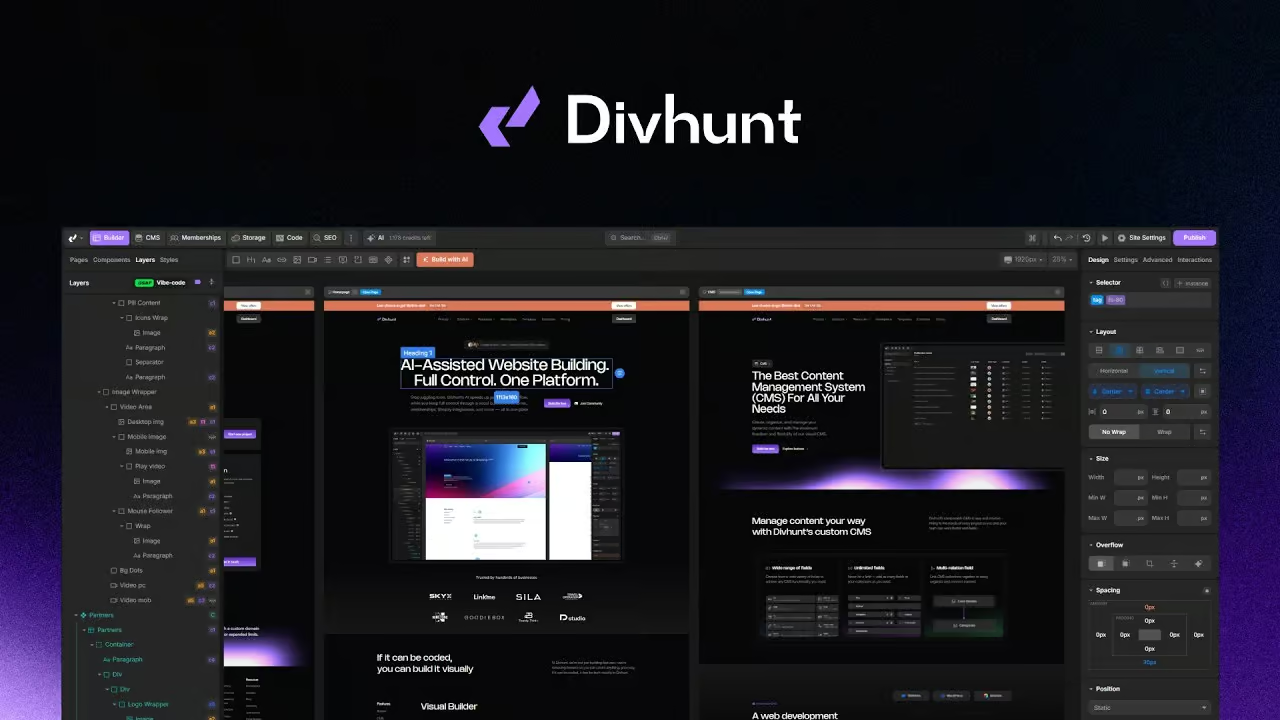
Today, cutting-edge website builders developed with SEO in mind include CDN hosting by default - like Divhunt.
Is It Necessary To Buy Hosting?
Depending on your website platform, buying extra hosting may not be necessary. In fact, today, the best website builders include fast and reliable hosting in all their plans - both free and paid.
Can I Host My Website for Free?
Yes, you can host a website for free in Divhunt.
As a leading website builder, Divhunt enables you to build and host a website for free in its global CDN hosting service, boasting lightning-fast speeds and 99.9% uptime - no matter where your users are located. As well, you can choose if server location is in USA or EU.
Ready to start? Build a website for free.