







So, you have decided to make your own website from scratch. Now what?
Well, the good news is that today, if you have basic computer skills, e.g., using simple software at work, you can create an attractive website without involving a developer.
All you need is time, some guidance, and the willingness to take that extra step.
How To Design A Website From Scratch In 10 Steps
When designing a website from zero, there’s a certain sequence of steps to follow - some are faster and easier, while others take extra planning and reading.
Still, they are all essential to a good-looking and well-working website.
Step 1: Define Your Website’s Goal
What’s the purpose of your website?
- Showcase your work
- Generate traffic & leads
- Share information
- Build a community
- Sell products
The goal of your website will guide your design, structure, and content.
For instance, a portfolio website would have a clean look and impressive galleries, while a business site would need well-structured information and a branded design.
Also, Check What Your Competition Is Doing
What are others doing?
If you are looking for inspiration and ideas, visit some other sites similar to yours. Analyze their design, structure, and content, and notice what stands out.
You don’t need to be a copycat, but you also don't have to reinvent the wheel!
Keep what works for you and give some extra time on features that could set you apart from the competition.
Step 2: Choose Your Domain Name
For your domain name - www.example.com - pick something simple, short, or catchy that mirrors who you are or what your website is about.
Remember: A domain name stays with you for years to come. Your friends know it, your customers use it, Google indexes it, and your email accounts are @yourdomainname.com. So, choose wisely!
To get your domain name, visit a domain registrar’s website - like GoDaddy or Namecheap - where you can check availability and register it online.
Step 3: Choose Your Website Builder
This is a pivotal step - especially if you’ve never built a website before.
Today, there are various paid and free website builders. Some are better for novice web designers and offer more ready-to-use features than others.
You’ll eventually need to do some reading and check a bunch of factors like ease of use, features you’ll need, annual costs, and support options.
Here are some of the best website builders in the market today:
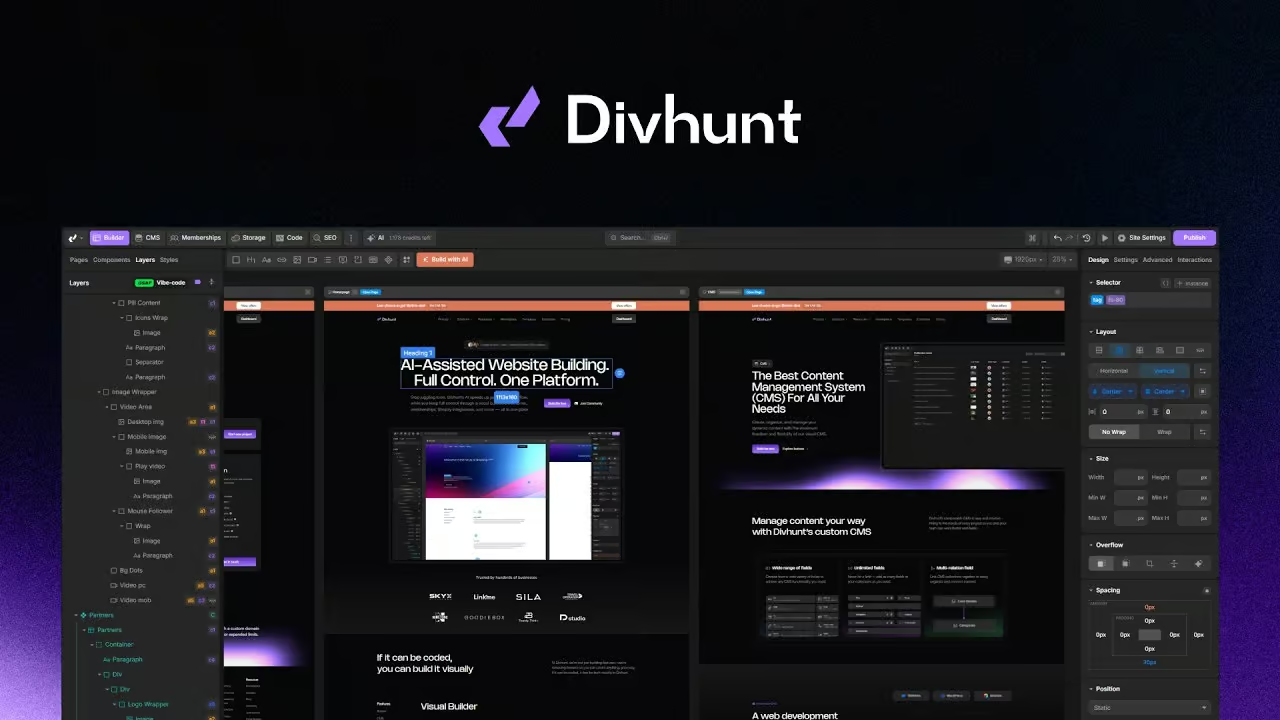
Divhunt
A drag-and-drop, no-code builder to create state-of-the-art websites even with little or no experience.
Divhunt comes with numerous free templates and various built-in features like animations and SEO (Search Engine Optimization) functions. Plus, you get everything you need right on the platform: fast CDN hosting, multi-language versions, plugins for extended functionalities, and more.
Divhunt’s a great choice for business websites that focus on scalability but also for multi-lingual and membership websites. Plus, you have the option to build a website for free when it comes to personal projects like portfolios or any small-scale endeavors.
WordPress
One of the oldest platforms for building websites and personal blogs. WordPress has hundreds of free templates to choose from, and it’s suitable for nearly any kind of website, from personal blogs to multi-lingual e-commerce stores.
Despite its versatility, WordPress leaves much room for mistakes if you lack in-depth knowledge. Unless you build something simple like a personal blog, you will have to choose among different builders that come with different templates and figure out various configurations and settings.
Plus, you’ll need to purchase a separate hosting plan and eventually add some paid extras like multilingual versions.
Still, WordPress can be a good choice for beginners who want to make a simple website from scratch.
Webflow
Webflow is another platform for drag-and-drop design. It offers many in-platform templates and a long list of plugins for extra functionalities.
Its nocode environment helps you create beautiful websites pretty fast, though compared to other builders, Webflow has some functions that are not straightforward, or they may need extra coding - adding up to a rather rigid architecture.
Webflow is a nice tool if you already have previous design experience or wish to add extensive animations to your website.
Wix
Wix is a simple, drag-and-drop website editor for people with minimal experience who want to make a basic website from scratch on a pre-built template.
However, Wix has limited flexibility and scalability, and it’s not a good choice for SEO - which is what actually helps your website appear on the first page of search engine results when people are looking for services like yours.
Multilingual and e-commerce features are also supported, but customization is limited without specialized knowledge.
Step 4: Pick A Hosting Plan (If Needed)
Every website needs its own space on a server - in other words, it needs hosting. Most of the builders above, like Divhunt, include fast and reliable hosting by default for enhanced website performance.
Others, like WordPress, need 3rd party hosting plans. In that case, choose a reliable hosting provider - like Bluehost or Hostinger- that offers fast, reliable, and secure hosting services as well as reliable support.
Step 5: Plan Your Website Structure
At this stage, you’ll need pen and paper (or a project management software) to do your site mapping.
Consider your site’s purpose from Step 1, along with all the information you want to show your visitors. How can you group it in a way that makes sense?
Start by brainstorming all the content you want to add to your pages. Then, see how you can organize different bits of information in small clusters.
Next, group these clusters under 4-6 broader categories, which will actually be your main menu items, and nestle your smaller clusters underneath as sub-menu items.
For example, on a psychologist’s website, the main menu category ‘Services’ would include sub-menu items like: One-to-One Sessions, Group Therapy, and Online Sessions.
Step 6: Choose Your Website Template
Take some time to choose an attractive template that’ll capture your future visitors' attention, and that’s also tailored to your needs and your niche.
As a beginner, try to pick a theme or template that’s almost ‘ready to use’ with minimal adjustments. Later, you can modify colors and sections, and even change the entire template for a fresher look.
Remember: Before you install your template, always check how it looks on desktop and mobile devices.
Plus, read through its ratings, number of downloads, and user comments. Both paid and free website templates may have technical drawbacks and limitations that existing users write about. Opt for a well-functioning template that’s been used on a good number of websites.
Step 7: Create Your Core Pages
When you build a website from scratch, it’s best to start small and grow your content gradually - especially if you are a beginner.
So, start by creating your ‘must-have’ pages:
- Home page
- Contact page - or place contact details on the footer.
- About page
- Services or Products page(s)
- Terms of Use & Privacy Policy pages - or any other legal pages required in your country.
- Blog page with individual blog posts - this is not a must-have, but today, it is a standard for all websites; plus, it helps a lot with SEO.
You’ll create and manage pages, layout elements, texts, and visuals via your platform’s CMS (Content Management System) - a user-friendly environment that helps you populate a website without extensive coding experience.
Visual builders like Divhunt, with drag-and-drop CMSs, allow you to slide content sections (i.e., placeholders) onto a new page and add your texts and visuals easily, leaving little room for mistakes.
Step 8: Add User-Inviting Content
Content is the cornerstone of any website.
True, a good-looking template grabs your visitors’ attention, but good content keeps them hooked and makes them come back for more.
Search engines also evaluate content to prioritize your pages in search results.
Always aim for informative, quality content that’s unique to your pages - and use AI assistance with caution. You’ll need to write a minimum of 300 words on every page in eloquent texts optimized for conversions.
Spice up your writing with catchy headlines, high-resolution images, gripping infographics, and self-made videos.
Step 9: Make Your Content SEO-Friendly
To get your pages noticed by search engines with less effort, choose a website platform with built-in SEO features - like Divhunt.
No matter what, make sure you include some basic SEO (Search Engine Optimization) elements in your website from day #1:
- Page titles & descriptions
- On-page headings
- Image alt tags
- Sitemap
- Internal links
Step 10: Test & Publish Your Website
Another thing to remember is to always test everything - before and after publishing.
This is crucial, especially when you launch a self-made website designed from scratch.
Get in your visitors’ shoes and diligently check all elements one by one:
- See that everything functions well in popular browsers like Chrome, Firefox, and Safari.
- Test your website’s responsiveness on different devices like desktops, mobile phones, and tablets (vertical and horizontal views).
- Verify that all interactive elements work correctly: click on every link and button, fill out and send your contact forms, or anything else.
Building A Website From Scratch: Some Things To Keep In Mind
If you are a beginner, one thing to remember is that creating a website is not like drawing on paper.
In other words, you can’t just ‘erase’ what you don’t like or play around with pages and designs until you get to what you want. Neither can you just change your domain name in a flash.
It’s not that you technically can’t. But doing so may leave behind anything - from unused pages and test images to redundant CSS (website styling) and unnecessary code. Such ‘website debris’ can eventually hurt your site if you don’t know how to deal with it.
So, once you decide to start a website from scratch, keep these 3 things in mind:
- Plan ahead
- Build thoughtfully
- Test everything
For optimal results, choose a robust website building solution that takes care of everything for you behind the scenes - like Divhunt. The cutting-edge website builder engineered for beginners and developers alike.
Ready to kick off? See how Divhunt helps you create stunning websites with minimal effort, no coding experience, and no hidden costs. Start building a website for free!