Today, when digital experiences can make or break a brand, your organization’s digital presence, amidst mobile phones, smart watches, smart speakers, and an ever-expanding landscape of online channels, needs a flexible and unified approach.
The days when a company website, backed by inflexible content management systems, was the single source of truth are long gone.
In its stead, innovative, versatile solutions empower businesses to pass their message across any medium and any device se
Welcome to the world of headless and hybrid CMS.
What Is A Headless CMS?
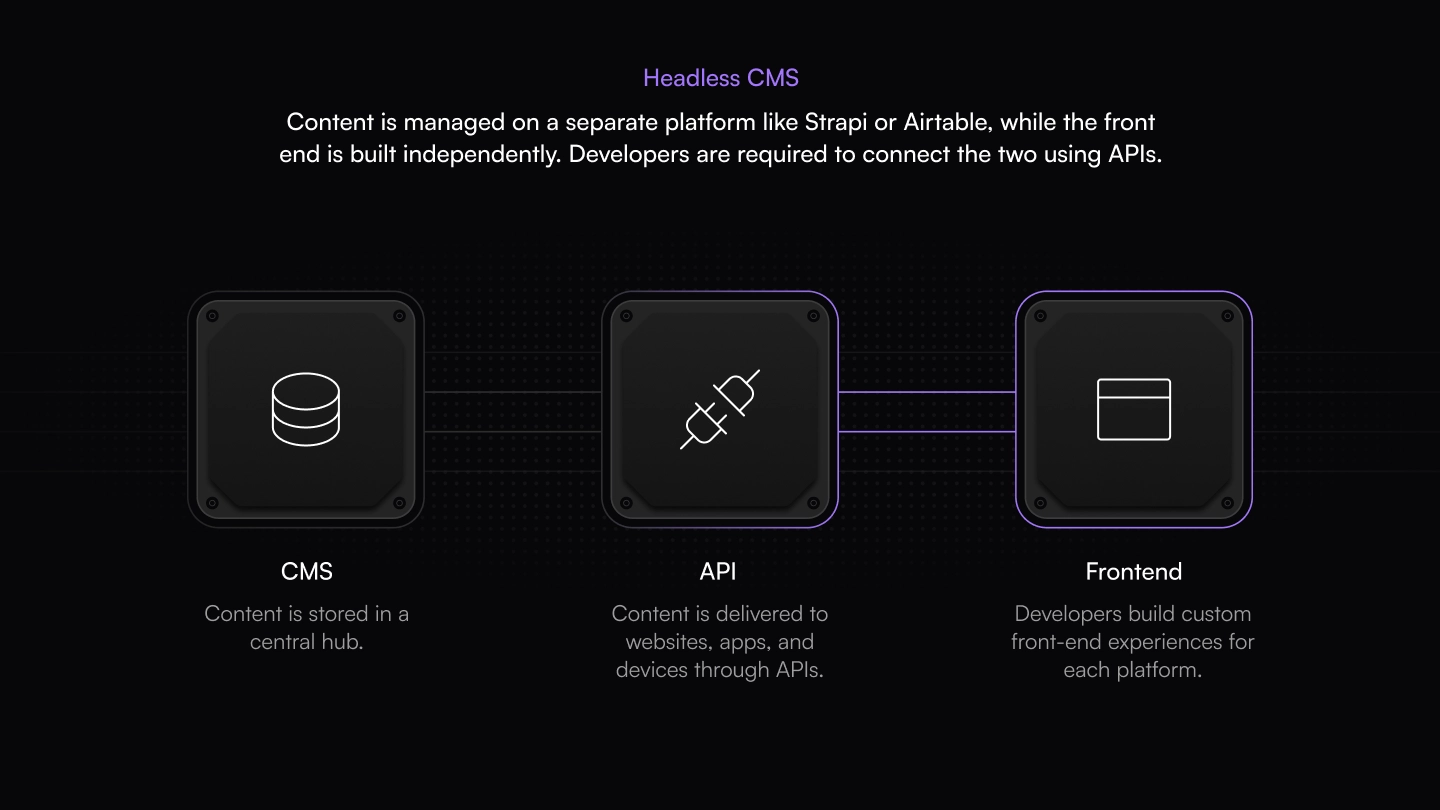
A headless CMS system separates the front end from the back end. All content is stored in the back end in a single content repository, accessed via APIs that deliver it front end on every digital channel and device.
Thus, developers can choose any technology they want without affecting what people see. And because the content is not restricted to a single channel, digital marketers can repurpose it without constraints.
This technology offers total flexibility to reuse and deliver content to your users’ favorite touch points along their customer journey. Thus, your marketing initiatives are freed from the constraints of rigid systems, the so-called ‘traditional’ CMSs.
So, What’s The Story Behind Traditional CMSs?
Years back, an organization’s digital marketing strategy centered around its website, attracting visitors with pretty layouts, informative texts, alluring images, and other front-end elements.
The back end was solely about the ‘developer-side’ of things, about servers and database information, in other words, all the elements that generally control actions like integrating rules, connecting pages, etc.
And, the entire website content was stored in the back end and presented to visitors in a rather rigid way via a ‘traditional’ CMS.
Today, though, marketers use all sorts of devices, channels, and apps to communicate their message. And this strategy can no longer work with systems where everything is tightly fastened together. It needs a headless approach.
Why’s It Called ‘Headless’?
To define headless CMS, developers used a wordplay. Remember: this system is built from the ground up as a repository where content is stored and managed independently of the presentation layer.
Content is then accessible via RESTful APIs in order to display on a device. So, the ‘head’ (the front end) is chopped off from the ‘body’ (i.e., the data or back end of the system) - hence the term ‘headless.’
In practice, the absence of an imposed ‘head’ opens the way for using content without limits, which, in turn, benefits your content strategies in various ways.
Benefits Of A Headless CMS
To keep up with the fast-paced digital marketing landscape and with customers who often value brand experiences more than the products (or services) themselves, more and more organizations opt for headless content management systems. And for some good reasons:
Flexibility
Marketers can instantly produce rich content tailored to their users’ devices and create customized experiences crafted for their favorite channels.
Indeed, organizations adopting a headless CMS have seen a 35% boost in user engagement via personalized content strategies!
Scalability
When using a traditional website, you need much more time to re-purpose existing content and adjust it properly for every screen and every channel - especially for unstructured data such as images or videos.
Plus, you are more likely to face technical drawbacks, like your website becoming really slow.
But thanks to APIs, headless CMS platforms offer enhanced scalability.
This is because they allow you to extend your content management beyond your website into any other platform, such as point-of-sale systems or online marketplaces, and get your message across when you need it and in the way you need it.
Future-Proof
As an API-driven solution, headless CMSs are front-end agnostic. Your content is safely stored in the repository, ready to be used in new channels whenever you wish.
Plus, you can rebuild your website without reinventing the wheel and impress your customers with different themes and different front-ends without touching your content.
The bottom line? You only need to do the work once to enjoy a significant ROI.
However, headless solutions, like everything else, come with their own drawbacks, like increased CMS development costs and complexities.
And also the fact that marketers and content authors are entirely dependent on developers.
You see, headless systems only include code - no text or image fields, no drag-and-drop capabilities, or other handy features that content authors can work with.
So, how can you speed up projects, facilitate the work, and make it more fun for all team members?
You can incorporate a user-friendly interface - similar to what the digital marketing staff is used to. In other words, you must couple the headless approach with the ‘classic’ CMS: Introducing the hybrid CMS.
What Is A Hybrid CMS?

A hybrid CMS (also called headless hybrid CMS) combines the advantages of headless platforms with ‘traditional’ content management features. It’s an omnichannel, front-end agnostic system that also provides a user-friendly interface for easy content management.
Hybrid CMS solutions have flexible API-driven features, but, at the same time, they provide individual levels of control to both developers and marketers so that each group can work independently.
Benefits Of A Hybrid CMS
Thanks to its versatile nature, hybrid CMS solutions are becoming increasingly popular. Here are 3 reasons why:
Offers Everything In One Place
Headless hybrid CMSs offer developers the flexibility they need to build flawless omnichannel content delivery. At the same time, they provide front-end templates and easy suite integrations that benefit marketers and enhance the authoring experience.
Website Building Gets Faster & Easier
Using the hybrid approach, website building takes less time and resources than a strictly headless system.
It also integrates smoothly with other platforms, facilitating work even further.
Makes Your Staff Happier
Because hybrid content management systems combine the best of both worlds, marketers can work more efficiently, using WYSIWYG editing and functions like content previews, personalization tools, and inline editing.
At the same time, developers don’t have to be there for content authors every small step of the way. They thus have more time to expand code-based capabilities and safeguard websites or other systems from getting bogged down.
Hybrid vs. Headless CMS: How To Choose The Right One for Your Business Growth
When choosing between a hybrid and a headless CMS, it all boils down to what you need.
First of all, consider your content needs, scalability targets, and development resources. And also which solution best fits into your existing architecture.
For instance, if you deal with an app or IoT device with limited editorial requirements, then eventually, a native cloud headless CMS will do the job.
But, if your project involves rich web content, extensive editorial requirements, or content reuse across different channels, then you’d probably be better off with a hybrid CMS.
Remember that a headless CMS centralizes control for multi-channel deployment and offers front-end flexibility for diverse user experiences.
On the other hand, hybrid platforms offer structured content management and headless flexibility for multi-channel delivery, along with an integrated approach for traditional websites.
So, if you are looking to scale your resources and your team’s capabilities, choose a code/nocode website builder that handles powerful API integrations to support your marketing strategies: Choose Divhunt.
Divhunt’s revolutionary architecture allows you to connect literally anything with visual REST API integrations and launch a powerful website on top of any headless CMS. Eager to find out more? Start a website with Divhunt.