








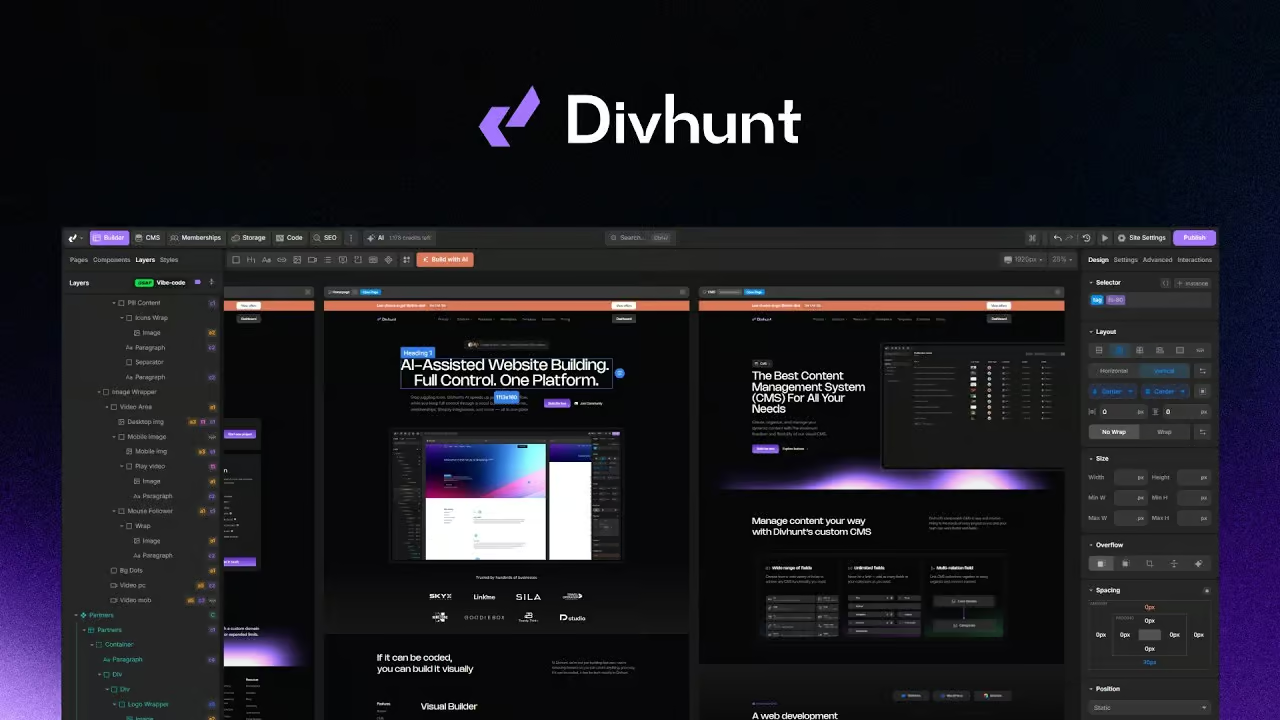

Semantic HTML output
Pages render as real, nested HTML tags you chose, with styles in a stylesheet instead of inline style attributes.
What you build in the Designer is output as the same HTML tags on the live site: an h2 stays an h2, a nav stays a nav. Styles are compiled into a CSS file with class selectors and media queries, not written inline on each element.
How it works
- The visitor renderer writes <tagname attributes> for each element; only embed, body, rich-text, form-widget and membership-form-widget are rendered as div.
- Element level styles compile to a generated class per element (.t<id>); classes compile to .classname; global tag styles compile to the tag selector.
- All selectors are scoped under main (tag styles under body main).
- Breakpoints compile to @media screen and (max-width: Npx), ordered from largest to smallest; the 1920 desktop base has no media query.
- Color swatches compile to CSS custom properties on main.
- Custom fonts compile to @font-face rules with font-display: swap.
- CSS is minified when the build asks for it.
When to use it
- Ship pages with a clean heading hierarchy for SEO
- Hand clean markup and CSS to a developer
Limitations
- Generated per element class names (.tNNN) are not human readable
- Some tags are not available (see HTML tags support)
- The alt fallback is the layer name, which may not describe the image
Availability
- Works in Designer.
- Included in every plan.
How to use it.
- Choose the right tag for each element
- Style with classes or element styles
- Publish; the CSS build compiles everything into the stylesheet
Questions.
Does Divhunt use inline styles?

Are breakpoints mobile first?
Related features.
All available HTML tags support
Build with real HTML elements: sections, headings, lists, media, forms and semantic tags like article, nav and aside.
Native class system
Create reusable CSS classes, combine several on one element, and edit them visually across breakpoints and states.
Custom breakpoints
Use the four default breakpoints or add your own pixel breakpoints, with a live width slider for each.
Direct tag styling
Style a single element directly in the Designer without creating a class first.
Image lazy loading
Images load lazily by default with native loading=lazy; switch individual images to eager.
Page meta title and description
Set the title and meta description each page shows in search results, with site-wide defaults as fallback.
Browse other features

Designer
Bring your ideas to life with our visual website builder. Drag and drop with ease, or dive into coding when needed.
→
AI Studio
Describe it and AI builds it. Every change lands in the same project you can open in the Designer.
→
MCP
Connect Claude Code, Cursor or any MCP client and build whole sites with your own agent.
→
CMS
Create, organize, and manage your dynamic content with the maximum freedom and flexibility of our visual CMS.
→
SEO
Divhunt delivers ultra-fast & structured sites that are good for ranking by default, while offering complete control for customization.
→
REST API
Easily link to any REST API endpoint with instant preview and expand your site’s functionality smoother than ever before.
→
Plugins
Divhunt offers an open platform for creating plugins to upgrade features, add new capabilities, and simplify building better sites.
→
Localization
Localize everything from static pages and CMS content to URLs and metadata, in up to 15 languages with no add-on.
→
Interactions
Visually create animations and interactions with a simple, intuitive timeline. Build smooth, engaging experiences without code.
→
Custom Files
Manage JS and CSS files with a structure developers love, combining folders and clean organization.
→
Memberships
Create plans, decide who sees what and connect it all to your CMS. Build courses, communities or client portals.
→